
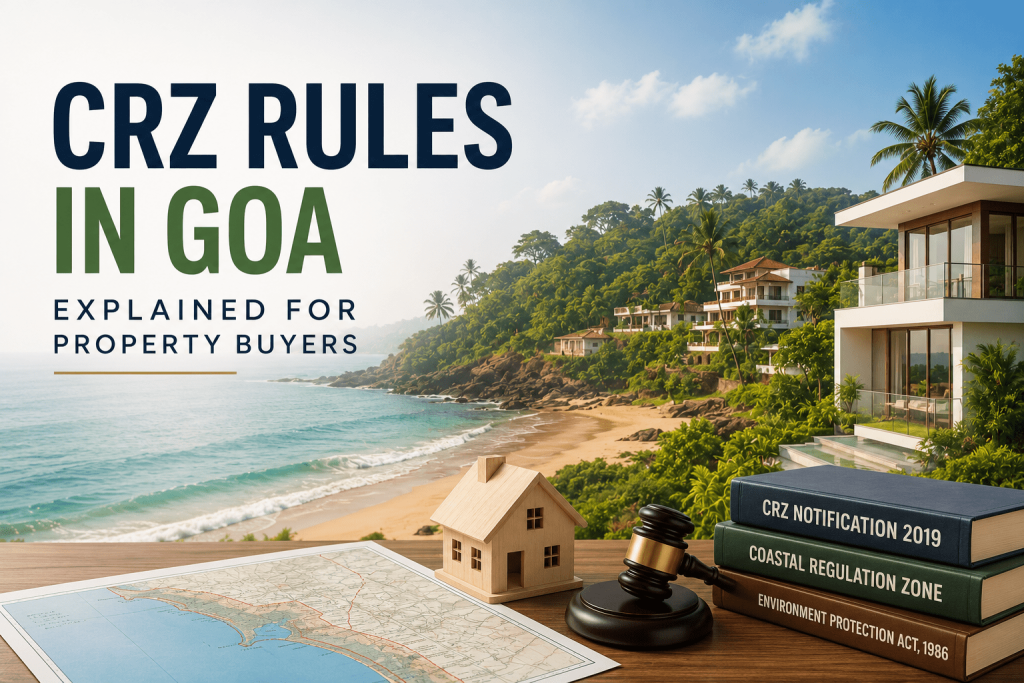
Buying property near the beach in Goa sounds like a dream. But before you sign on the dotted line, there is one legal framework every buyer must understand , the Coastal Regulation Zone, or CRZ. The CRZ rules in Goa govern what can be built, where it can be built, and who can build it along the state’s 105-kilometre coastline. Ignoring these rules has cost many buyers their investment. This guide breaks it all down in plain language so you can buy smart.
What Is CRZ and Why Does It Exist?
The Coastal Regulation Zone is a protected buffer established by the Indian government under the Environment Protection Act, 1986, and revised under the CRZ Notification 2019. Its purpose is to protect fragile coastal ecosystems, beaches, mangroves, tidal flats, and sea life — from uncontrolled construction and development.
In Goa, the CRZ rules in Goa are enforced by the Goa Coastal Zone Management Authority (GCZMA). Any construction within the designated coastal stretch requires prior clearance from this body. Violations can result in demolition orders, heavy fines, and even criminal liability for both the builder and the buyer.
How Far from the Sea Can You Build in Goa?

This is the most common question buyers ask, and the answer depends on which CRZ category your plot falls under. How far from the sea can you build in Goa is determined by the High Tide Line (HTL) — the point where the sea reaches its highest natural level. Here is a breakdown:
- CRZ-I (Ecologically Sensitive): No construction permitted within 500 metres of the HTL. This covers mangroves, coral reefs, and national parks along the Goa coast.
- CRZ-II (Urbanised Areas): Construction is permitted on the landward side of existing roads, following local building bye-laws. No new construction seaward of the existing development line.
- CRZ-III A (Densely Populated Rural): Construction not permitted within 50 metres of the HTL. Applicable to villages with a population density above 2,161 per sq km.
- CRZ-III B (Other Rural Areas): No construction within 200 metres of the HTL. Most of Goa’s lesser-developed coastal stretches fall here.
- CRZ-IV (Water Zone): Covers the area up to 12 nautical miles into the sea. Regulates fishing and aquaculture activities.
As a general rule of thumb for buyers: if a plot is within 200 metres of the sea in a rural Goa village, it is almost certainly under CRZ restriction. Always verify before purchase.
CRZ Exemptions for Residential Property in Goa
Not everything near the coast is prohibited. There are specific CRZ exemptions for residential property in Goa that buyers should know about:
- Repairs and reconstruction: Existing structures within the CRZ zone can be repaired or reconstructed to the same floor area, provided they existed before the CRZ notification.
- Local fishing communities: Houses built by traditional fishing communities (Kolis) within the CRZ zone are exempt from most restrictions under CRZ-III provisions.
- CRZ-II development on existing road lines: In urbanised coastal areas classified as CRZ-II, construction on the landward side of existing, authorised roads is permitted as per local panchayat or municipality bye-laws.
- Tourism projects under CRZ-III A: Temporary tourist structures like beach shacks are permitted on a seasonal basis but require annual GCZMA approval.
- Heritage structures: Renovation and restoration of heritage properties within CRZ zones may be permitted with specific clearances.
Important: CRZ exemptions do not automatically apply. Each case requires verification with GCZMA and a licensed architect who understands Goa’s coastal planning laws. Do not rely solely on a builder’s verbal assurance.
How to Do a CRZ Compliance Check on Goa Property
A CRZ compliance check on Goa property is a non-negotiable step before purchase. Here is a practical checklist:
- Obtain the CRZ map: Ask GCZMA for the official Coastal Zone Management Plan (CZMP) map of the taluka where your plot is located.
- Check Form I & XIV: Verify the land’s title and mutation records. Confirm the survey number and cross-reference it against the CZMP map.
- Request GCZMA clearance history: If the seller claims existing CRZ clearance, ask for the written order from GCZMA. Verbal claims are worthless.
- Hire a CRZ-aware architect: Before finalising any purchase for development, get a written opinion from a registered Goa architect on what can and cannot be built on the plot.
- Check for violations: Search for any existing stop-work orders or demolition notices issued against the property at the GCZMA office or South Goa District Collector’s office.
- Insist on RERA registration: For projects in or near CRZ zones, confirm the developer holds valid RERA registration and that the project’s environmental clearances are in order.
CREC conducts full CRZ compliance checks for all clients as part of our property due diligence process — at no additional cost.
What Happens If You Buy a CRZ-Violating Property?
The consequences are severe. Understanding the CRZ rules in Goa is not just about compliance it is about protecting your investment:
- The National Green Tribunal (NGT) has ordered demolition of hundreds of illegal coastal structures in Goa in recent years.
- Banks may refuse to provide home loans for properties flagged as CRZ non-compliant.
- You cannot legally sell, lease, or mortgage a property with a pending CRZ violation.
- The buyer, not just the builder, can be held liable if the violation occurred after purchase.
Frequently Asked Questions
Do CRZ rules apply to all properties in Goa?
Only properties within the designated Coastal Regulation Zone — typically within 200 to 500 metres of the High Tide Line — are directly affected. Properties farther inland are not subject to CRZ regulations, though other planning and environmental laws may still apply.
Can I renovate an existing house in a CRZ zone in Goa?
Yes, in most cases. If a structure legally existed before the CRZ notification and you have documentary proof, you can repair or renovate it to the same footprint and floor area. Expansion is generally not permitted without GCZMA clearance.
How do I find out if my plot is in a CRZ zone?
You need to obtain the Coastal Zone Management Plan (CZMP) map for the relevant taluka from the GCZMA office in Panaji. Your plot’s survey number can then be cross-referenced to determine its CRZ classification. CREC can assist you with this CRZ compliance check on Goa property as part of our buyer advisory service.
Are there CRZ exemptions for residential property in Goa for NRIs?
NRIs are subject to the same CRZ exemptions for residential property in Goa as resident Indians. There are no additional exemptions based on NRI status. The exemptions are tied to the property’s classification, its history, and its use, not the buyer’s residency status.
What is the penalty for a CRZ violation in Goa?
Penalties under the Environment Protection Act include fines of up to ₹1 lakh per day of violation, imprisonment of up to five years, and mandatory restoration of the damaged coastal environment. The NGT can also order demolition of the illegal structure at the owner’s cost.
Invest in Goa Property with Complete Legal Confidence
Navigating CRZ rules in Goa can be complex, but with the right expert by your side, it doesn’t have to be. CREC’s team conducts thorough CRZ compliance checks, title verifications, and RERA confirmations for every property we recommend, so you can invest with total peace of mind.
“Buying coastal property in Goa is exciting, but one CRZ mistake can cost you everything. Let CREC Goa handle the compliance checks, title verification, and legal groundwork so your investment stays protected from day one.” Contact us today